Retrospective exhibition

Thresholds
of Reality

Dinka Pignon

Opening & reception
September 10, 2026 · 19:00

Exhibition
September 10 – October 1, 2026

Heritage House / Kuća Legata
Kneza Mihaila 46, Belgrade

Curator: Ivona Fregl

This retrospective brings together seven installations that explore the unstable thresholds between the real and the virtual. Through projections, interactive environments, and AI-mediated presences, the works probe the spaces where perception falters and meaning wavers.

From the ghostly dinner table where real and virtual guests share a meal, to pools of water animated by spectral bodies, the installations reveal how language, technology, matter, and presence intersect in zones of uncertainty. Mannequins that chant art manifestos in synthetic voices, stones that speak in invented tongues beneath a rain of falling signs, and human and AI figures confronting one another across an artificial enclosure all stage encounters where illusion is not deception but revelation—an invitation to dwell in ambiguity.

The exhibition resists closure. Its works circle back on themselves, looping conversations, shifting symbols, images that never quite settle. They reflect our own contemporary condition: where human and machine, body and code, stone and screen, are constantly reconfigured in overlapping realities. Rather than offering resolution, the exhibition insists on the richness of indeterminacy. Here, illusion becomes a source of intimacy, and the virtual is not an escape but another mode of presence.
Seven installations

01

Not Sure (2010)

Video sculpture

Sound: Emma Hendrix & Lujka Petrović

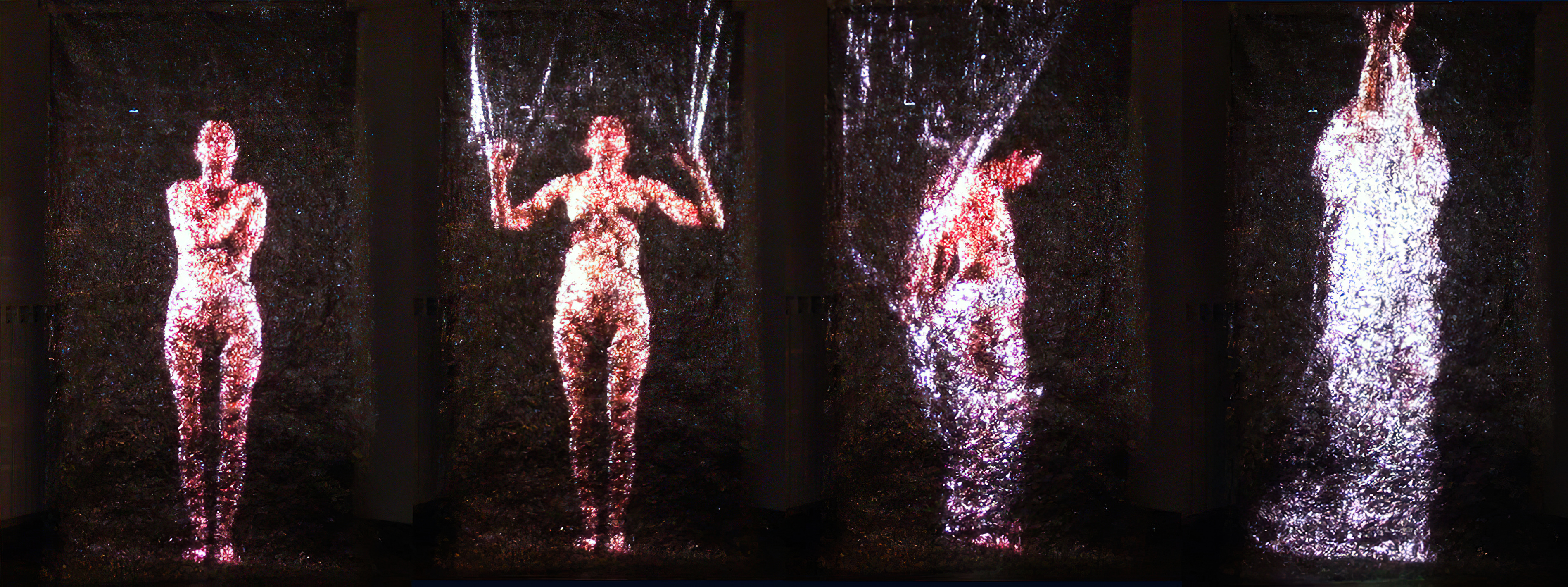
Not Sure installation, projected female figure on layered cellophane

Not Sure plays with perception. Video of a female body wrapping itself in a cellophane curtain is projected onto that same curtain, crinkled and layered to give the image volume. The viewer is left uncertain: is the body physically present, or only a projection?

The mind struggles with ambiguity, always seeking certainty. But this decisiveness comes at a cost: richness and subtlety are lost when experience is forced into concepts. Not Sure invites the viewer to linger in uncertainty, to inhabit the space between seeing and knowing.

02

Pool Currents (2003)

Video installation

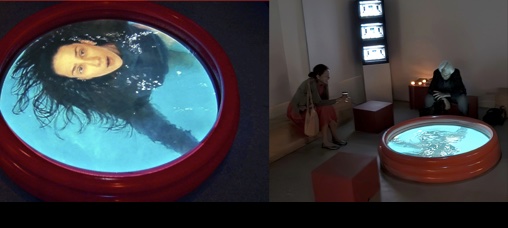
Pool Currents installation with projected swimmers in a water-filled pool

A simple plastic wading pool functions as an interface between matter and medium—a threshold between realities. Filled with water, it receives the projection of swimmers diving, colliding, fooling around, and splashing about. The water refracts and animates the images. The pool is at once a physical object and a screen, where image and element entwine in a current of appearance and dissolution, suggesting that what we perceive as solid is always provisional.

Some viewers linger silently, watching as if before a fire. Others toss coins into the pool as if it were a fountain—a site of desire, ritual, and shared imagination. In this convergence of real and virtual, the installation transforms a modest container into a collective space where image, matter, and gesture flow together in an ever-shifting current.

03

Dinner for Corporeal & Radiant Beings (2003)

Participatory video installation

Dinner for Corporeal and Radiant Beings installation with live and projected dinner guests

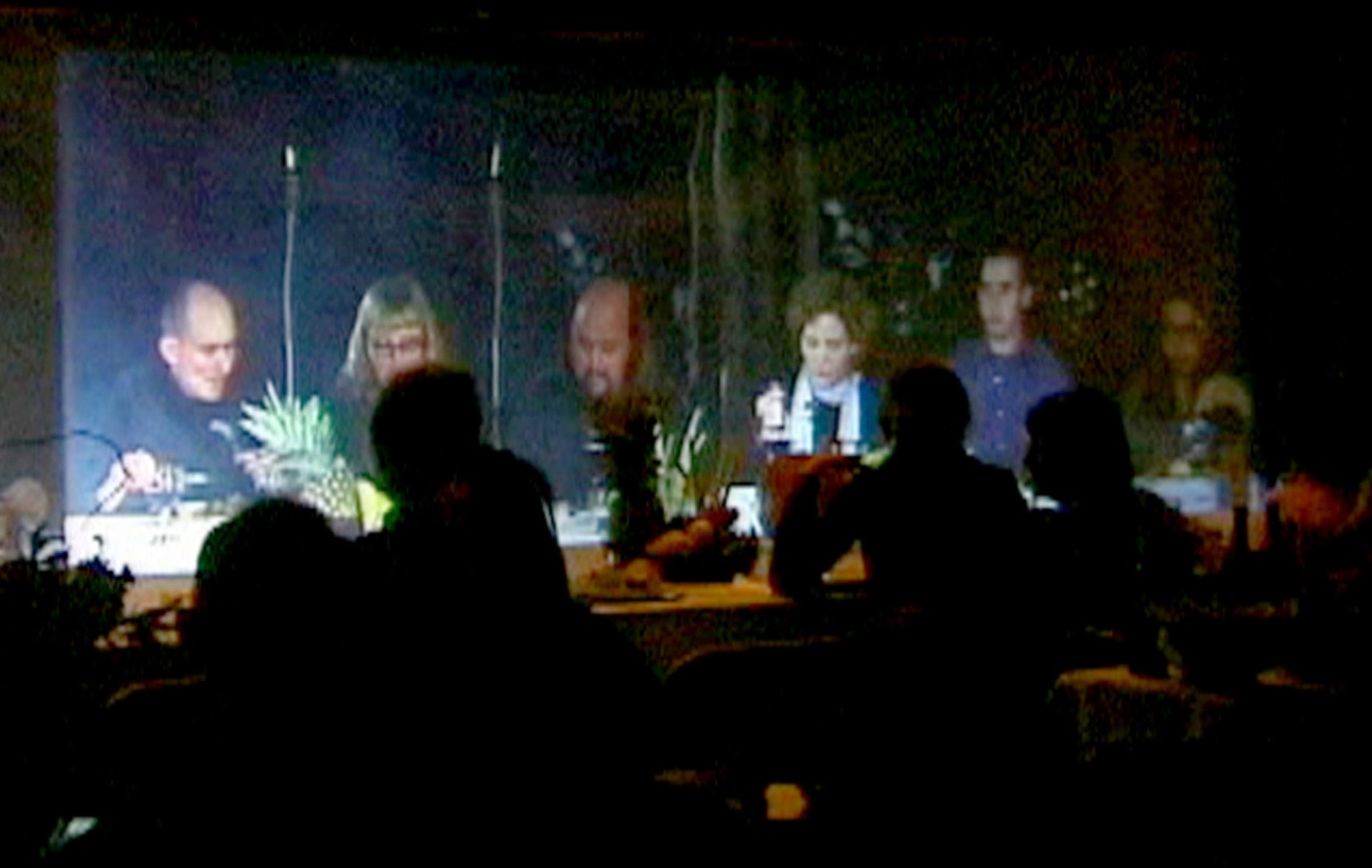
Dinner is an immersive video installation inviting the audience into a surreal, participatory social environment. The work explores the shifting boundaries between virtual and physical interaction, prompting reflection on contemporary urban communication.

A wall of video projections depicts 12 people dining. In front of the screen, a real table is placed and aligned with the video table, forming the illusion of a single extended table. Audience members are invited to join the dinner and engage with the projected guests—ghostly presences that blur the line between real and virtual.

Throughout the event, a waitress circulates, serving food and drinks to both real and virtual guests, moving seamlessly between the physical space and the projection. This performance underscores—and at times subverts—the illusion of continuity between worlds. Audience participants take turns at the table while a conversation unfolds around the theme of virtual reality, as if the artwork were discussing itself. Video guests address the real diners directly, and voices appear to respond from the audience; in fact, all dialogue is pre-recorded, creating a deliberate tension between the live and the staged.

04

Elementals (2012)

Sculptural video installation

Sound: David Leith, with Idle Chatter by Paul Lansky

Elementals installation with projected faces on rocks

Elementals is a sculptural video installation where projection inhabits matter. Sand covers the floor, anchoring three large rocks. Projected onto them are talking heads that chant in invented tongues, fall silent, then resume their incantations. Above, a multi-layered, invisible screen of black tulle receives cascading letters, falling like rain. They shift from hieroglyphs and medieval signs to the modern alphabet, appearing to drop onto the heads below.

The work reflects on the mystery of language, tracing its figurative origins and its shifting role from ritual to contemporary use. Letters seem light yet carry weight; voices resonate within stone under a rain of meaning. Language is experienced as something seen, heard, and felt.

05

Orchestra of the Uncanny Valley (2014)

Sculptural video installation

Sound designer and composer: Emma Hendrix

Performer: Sharon Sabatino

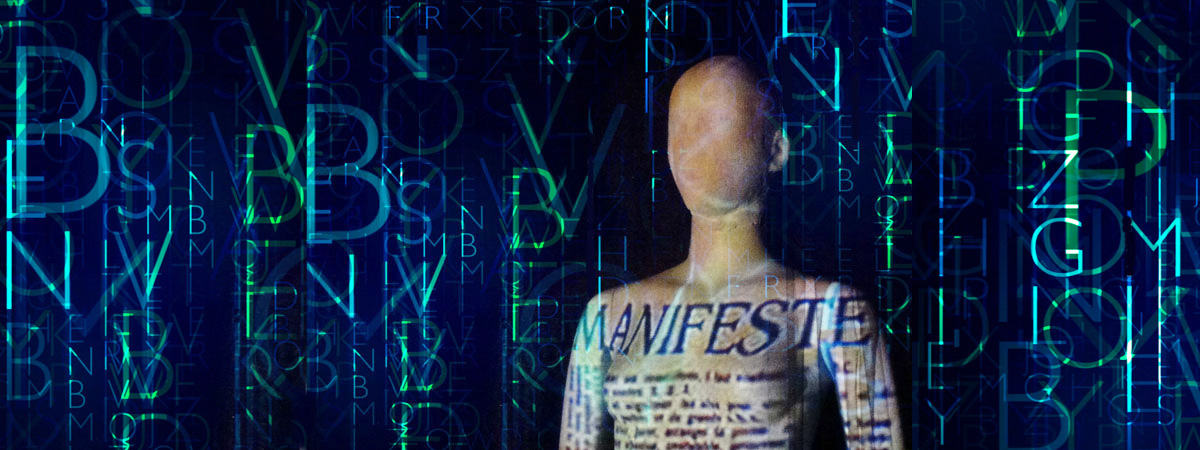
Orchestra of the Uncanny Valley installation with projection on a mannequin

Orchestra of the Uncanny Valley is a sculptural video installation in which projected video and sound animate mannequins and a translucent volumetric screen. Layers of fine black tulle form a semi-transparent environment that both captures and transmits the projection, giving the moving image a ghostly, three-dimensional presence. Three mannequins, placed among these layers, become figures within the projection itself.

Each mannequin hosts a projection of the same person. They speak in unison, reciting lines from canonical art manifestos. Their voices are modulated—half-human, half-synthetic—while their bodies carry shifting overlays of abstract images, artworks, and text, like garments in perpetual metamorphosis.

The work plays on the psychology of the uncanny valley—the unsettling zone where human replicas appear almost, but not quite, real. The installation holds viewers in a state of perceptual conflict, where the familiar and the strange collapse into one another.

By staging this tension, the work probes “art as social phenomenon”: how ideas harden into categories, how habits of perception shape experience, and how voices from realism, futurism, and dada might echo through an imagined AI consciousness.

06

Game Over (2016–2026)

Sculptural video installation with audio

Sound designer and composer: Kenneth Newby

Performer (Human and AI agent): Sharon Sabatino

Philosophical discourse: Derek Robinson and Ajahn Sona

Creative consultant: Ajahn Sona

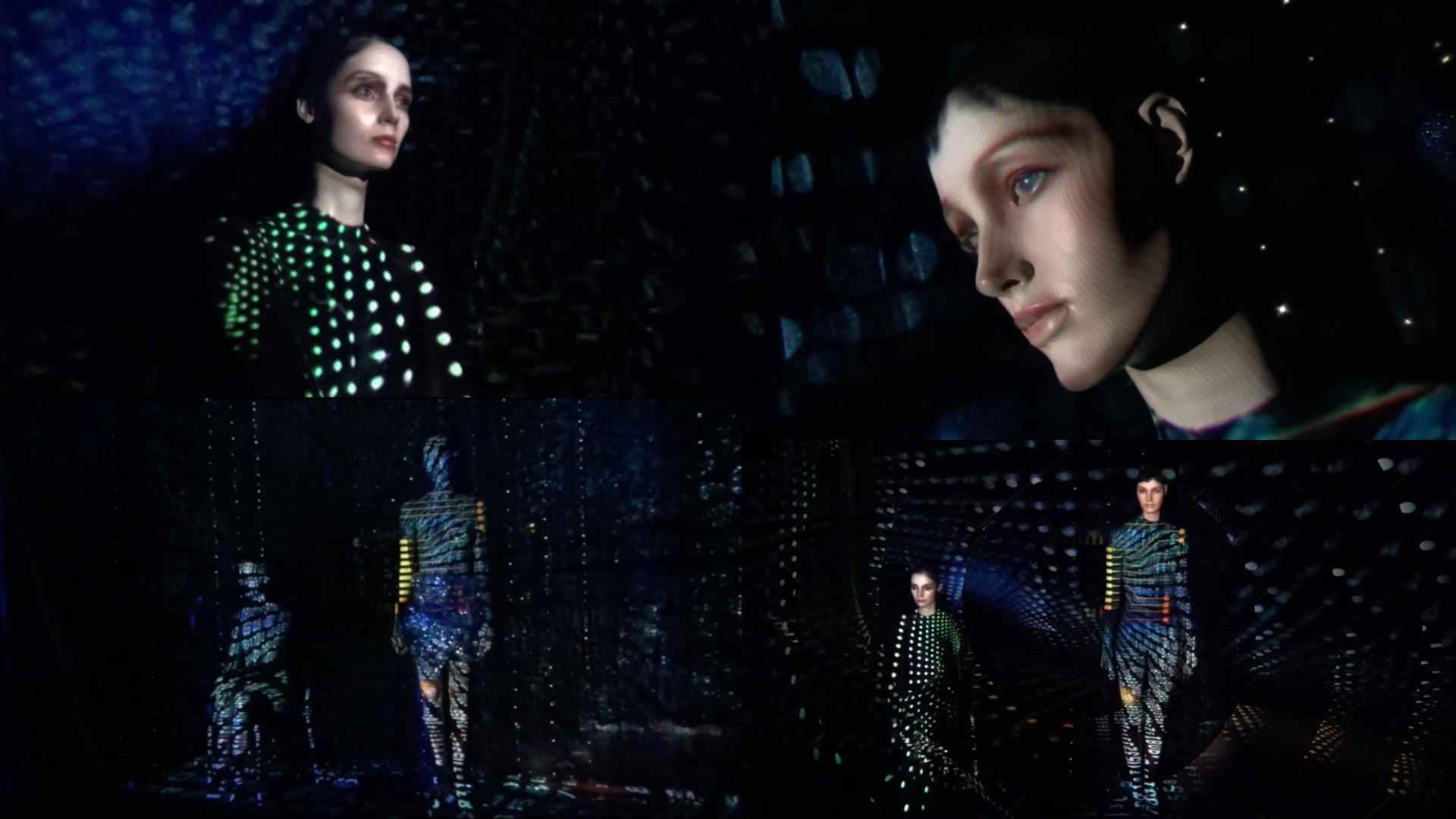
Game Over work-in-progress, projected human and AI figures

Game Over reflects on the relationship between artificial and human intelligence at a time when the machines we create are beginning to acquire qualities that resemble conscious life, while we humans gradually change our own ways of being as we adapt to increasingly frequent interactions with those machines. Are we becoming them, or are they becoming us? Or both? Will the difference become so blurred that the distinction can no longer be made? Will we even notice the shift?

The work unfolds through three interwoven dialogues: between a Human and an AI agent, Siri and a random user, and a philosopher and a Buddhist monk.

The central axis of the installation consists of two full-size mannequins, animated by projected human faces and garments, embodying the Human and the AI agent. The AI inhabits a house-like environment of animated matrices and shifting light, while the Human remains outside this artificial world, addressing the AI from beyond its enclosure.

Their exchange is punctuated by fragments of conversations between Siri and a random user, recalling encounters with an earlier generation of artificial intelligence that now seem both familiar and strangely poignant.

Running through the installation is an extended philosophical discourse exploring consciousness, perception, free will, reality, and the nature of mind.

Rather than offering answers, Game Over places technological experience alongside philosophical inquiry, inviting viewers to consider not only what artificial intelligence may become, but also what our attempts to create it reveal about ourselves.

07

Rocks

Mixed-reality installation

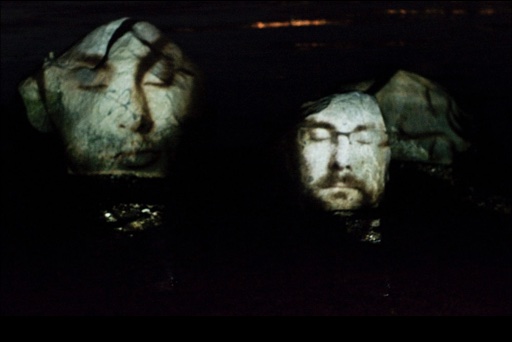
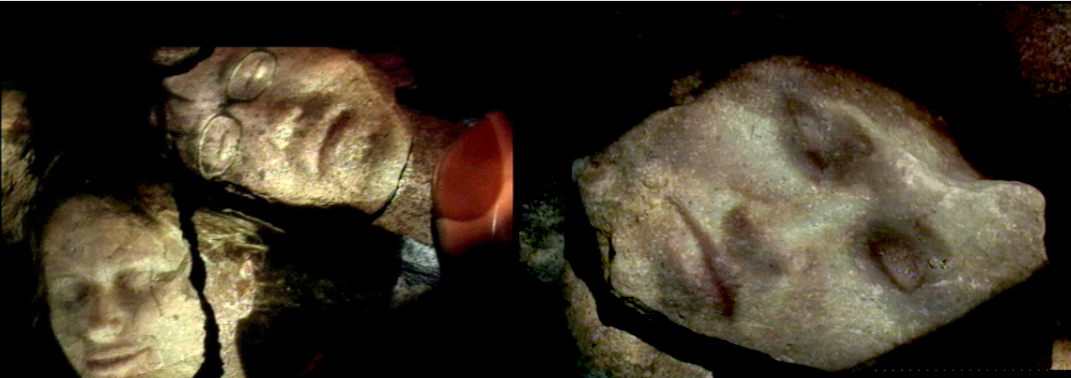
Rocks installation with faces projected onto stones

A video of six sleeping faces is projected onto a pile of rocks lying on the floor, each face occupying a single stone. Image and matter permeate and transform one another. The work rests at that unstable meeting point, where the faces acquire the weight and permanence of stone, while the stones take on the lightness and temporality of the projected image. What emerges is neither image nor object, but a new, temporary form produced by their encounter.

Occasionally, one of the projected faces opens its eyes for a brief moment, then closes them again. The gesture subtly points to a question that recent developments in AI have made increasingly difficult to ignore: where, if anywhere, is the boundary between the animate and the inanimate when it comes to consciousness? Some viewers will notice it; most will not. As in life, those who look closely and wait patiently stand a better chance.

Canada Council for the Arts / Conseil des arts du Canada

We acknowledge the support of the Canada Council for the Arts.